
Let’s Go to Milano
Set at the heart of northern Italy, Milan carries the legacy of a Roman stronghold, the power of medieval duchies, and the confidence of Italy’s economic and creative capital. Twice a year, Milan Fashion Week transforms the city into a global stage, while institutions like the Triennale anchor its ongoing dialogue with art, design, and architecture — not as spectacle, but as a natural extension of daily life. It is a city that challenges, energize and stays with you long after you leave.
Milan today is often misunderstood. Known globally for fashion, finance, and speed, it is rarely approached with patience. For years, its efficiency and ambition overshadowed its subtler beauty. While other cities leaned into romance and nostalgia, Milan focused on work, innovation, and progress. Visiting it with an open eye reveals a city of depth and discipline, where elegance is purposeful and culture is woven into everyday life rather than displayed for spectacle.
Historically, Milan was never meant to be decorative. From Roman Mediolanum to the rule of the Visconti and Sforza, it was shaped as a center of power, strategy, and production. This history lives on in its structure: formidable castles, rational streets, and architecture that values function as much as form. Even its most iconic symbol, the Duomo, is less about excess than persistence — a masterpiece built over centuries, reflecting patience, ambition, and collective vision. Milan is a city built to work, to lead, and to endure.
For a long time, Milan was seen as serious, even austere — a place of business rather than beauty. That perception kept its cultural life understated, protected from overt tourism. Today, this restraint defines its appeal. Museums, galleries, design spaces, and contemporary architecture coexist seamlessly with historic neighborhoods. Milan feels alive and intense, but never chaotic — stylish, but never superficial.
For me, Milan is a city of momentum. It teaches you to refine your eye, sharpen your ambition, and move with intention. Walking its streets feels purposeful, as if the city expects something of you. Sharing Milan is not about showing highlights, but about revealing a way of life — one that rewards curiosity, effort, and attention to detail.

Duomo di Milano
Places to See
Milan reveals itself in layers. The Duomo stands at its center, vast and luminous, its white marble façade an anchor for the city’s constant motion. From its terraces, the city stretches outward — rooftops, spires, and on clear days, the faint outline of the Alps in the distance. Nearby, the Galleria Vittorio Emanuele II acts as Milan’s living room, where architecture, fashion, and daily rituals intersect beneath soaring glass ceilings.
Castello Sforzesco marks the city’s historic power, opening onto Parco Sempione, a rare expanse of green where Milan briefly exhales. Brera offers a softer rhythm — cobbled streets, art academies, and galleries that balance refinement with intimacy. Here, Milan feels contemplative, artistic, and quietly elegant.
Further south, the Navigli trace the legacy of Leonardo da Vinci’s canals, transforming evenings into social rituals by the water. Contemporary Milan rises in Porta Nuova and CityLife, where glass towers and bold architecture signal the city’s forward gaze. This coexistence of old and new defines Milan: a city constantly reinventing itself without erasing its past.
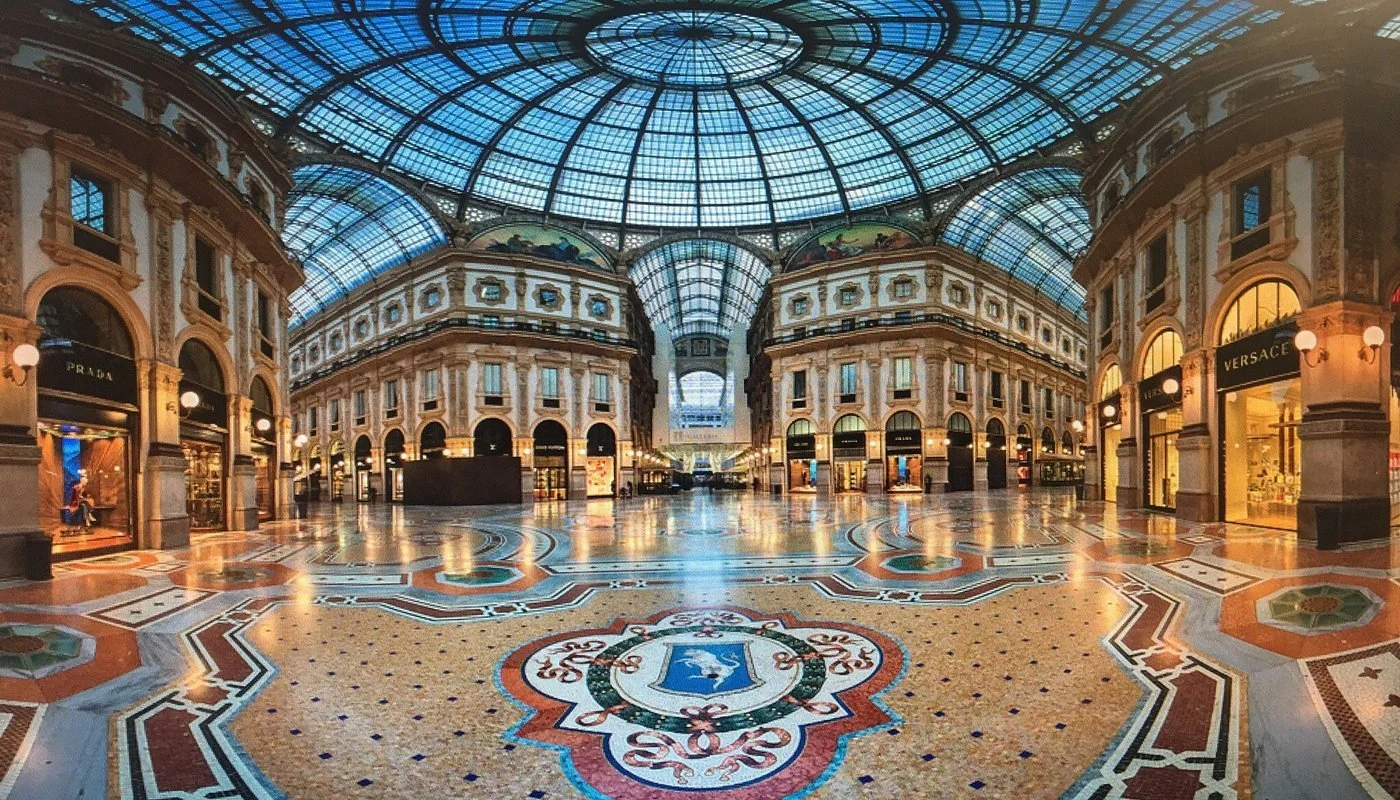
Galleria Vittorio Emanuele II, an aesthetic experience beyond shopping.
What to Do
Life in Milan moves decisively, but it rewards those who adapt to its cadence. Begin the day standing at the bar of a historic café — Marchesi, Pavé, or Sant’Ambroeus — where espresso is swift, precise, and deeply ritualized. Mornings are efficient, focused, and unmistakably Milanese.
Lunch is often purposeful yet refined. Trattorias like Trippa, Cantina della Vetra, or Ratanà celebrate Lombard cuisine with dishes such as risotto alla milanese, cotoletta, and osso buco, prepared with respect for tradition and quality ingredients. For a more elevated experience, restaurants like Il Luogo di Aimo e Nadia reinterpret classic flavors with contemporary vision, reflecting Milan’s balance between heritage and innovation.
Afternoons invite exploration. Wander through Brera’s side streets, explore concept stores and independent designers, or step into the quiet of the Pinacoteca di Brera for a moment of reflection. Quadrilatero della Moda offers a different perspective — polished storefronts, historic ateliers, and the unmistakable confidence of Italian style. Beyond the labels, smaller streets reveal tailors, fabric shops, and craftsmanship that still define Milan’s fashion identity.
As evening approaches, aperitivo becomes a ritual. Along the Navigli or in understated wine bars like Cantina Isola or Bar Basso, conversation flows as easily as the drinks. Dinner may follow late, unhurried, and intentional. Evenings in Milan feel composed and assured — less about display, more about presence.
Milan does not ask for admiration. It expects engagement. And those who meet it on its own terms discover a city that is disciplined, creative, and quietly magnetic — a place where ambition and beauty coexist in perfect balance.
Would you like to visit Torino?
With The Italian Vibe, every visit is personally curated,
offering exclusive access to vineyards, cellars, and tastings — crafted entirely for you.